


Why Nordic Poles Are a Game-Changer for Seniors and People with Parkinson's

Walk Stronger, Move Safer: Why Nordic Poles Are a Game-Changer for Seniors and People with Parkinson's
Balance. Confidence. Independence. Sometimes all it takes is the right tool.
Walk Stronger, Move Safer: Why Urban Poling's Activator® Poles Are a Game-Changer for Seniors and People with Parkinson's
Balance. Confidence. Independence. Sometimes all it takes is the right tool.
If you've been looking for something that gives you more stability and confidence on your walks without the bulk of a walker or the limitations of a cane we want to introduce you to something we carry right here at the gym: the Urban Poling Activator® poles.
These are not your average trekking poles. They're not hiking gear. They are a purposefully designed, evidence-based mobility and rehabilitation tool and for many of our clients living with Parkinson's or managing balance challenges, they've been genuinely life-changing.
Let's talk about why.
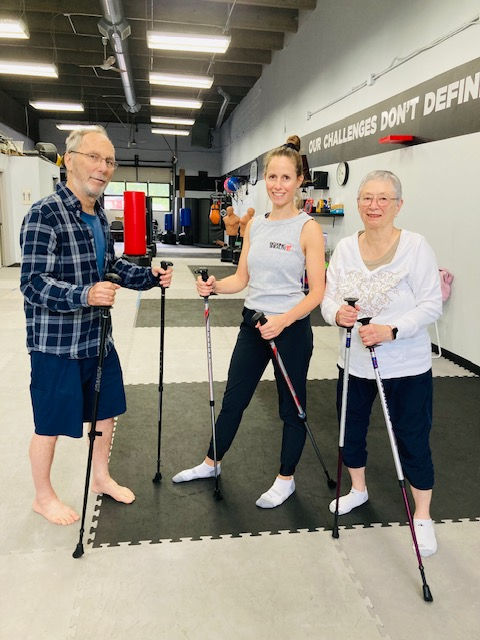
Built for Real People, by Real Clinicians
The Activator® poles were designed by an Occupational Therapist and Gerontologist — someone who works with older adults and people with mobility challenges every day. That background shows in every feature.
Urban Poling is a proudly Canadian, women-owned company founded in 2005, and the Activator® poles are now backed by 18 independent studies at universities and hospitals across Canada, the USA, Israel, Iran, and the renowned Royal Orthopaedic Hospital in London, UK. They've been recommended by leading surgeons, physicians, and therapists, and are the first and only walking pole certified for Ease of Use by the Arthritis Foundation.
This isn't a fitness product that got repurposed for rehab. It was designed for rehab from the ground up.
How the Activator® Poles Work — And Why They're Different
Here's what makes these poles stand out from a generic Nordic or trekking pole:
The CoreGrip™ — Strapless and Smarter
Traditional Nordic walking poles have a strap that loops around your wrist. That sounds helpful — until you trip. Research has shown that the most common injury in Nordic walking happens when a person falls and their hand remains attached to the pole.
The Activator® poles use a wide-ledged, strapless CoreGrip™. You rest your hand on the ledge — no strap, no attachment. If you stumble or lose your balance, you simply let go. That's a meaningful safety difference for anyone with a fall risk.
The CoreGrip™ also supports your wrist in a neutral position, reducing strain on the wrist, elbow, and shoulder — especially important for anyone with arthritis, weakness, or joint sensitivities.Four Points of Contact — Every Step
Unlike a cane (one hand, reactive) or a walker (forward-leaning, shuffling), Activator® poles are used with both hands, kept vertical and in front of the body at all times. Arms are bent at 90 degrees and swing in a natural, coordinated rhythm.
The result: four points of contact with the ground — your two feet plus two poles. That dramatically widens your base of support and gives your nervous system far more information about where you are in space with every single step.
Built to Bear Weight
These poles aren't decorative support. Each pole has a 200 lb (90 kg) weight-bearing capacity, with a secure button-locking system (easier and safer than twist locks). They're built for people who genuinely need to lean on them.
Bell-shaped rubber tips provide stability on indoor floors, pavement, and packed surfaces. Flip to the carbide steel tips for icy or slippery terrain a feature that matters here in Ottawa.
The Case for Balance and Fall Prevention
Falls are one of the leading causes of injury in adults over 65 and fear of falling can be just as limiting as a fall itself. The Activator® poles address both.
Upright posture. The poles naturally encourage you to stand tall and open your chest. For anyone who has developed a forward lean over time, this postural cue makes a real difference in how you move and how you feel.
Reduced joint load. Poles offload weight from your hips and knees into your upper body, reducing pain and fatigue which means you can walk longer, with more confidence.
Improved gait. Research consistently shows that walking with Activator® poles improves stride length, walking speed, and overall walking pattern less shuffling, more purposeful movement.
Full-body engagement. When you use Activator® poles properly, you're not just walking. You're activating your arms, shoulders, upper back, and core burning up to 20–46% more calories than regular walking at the same pace.
Activator® Poles and Parkinson's: A Closer Look
Parkinson's disease affects movement in ways that go well beyond tremor. Freezing of gait, reduced arm swing, shuffling steps, forward posture, and difficulty initiating movement are all part of the picture. The Activator® poles speak directly to many of these challenges.
Rhythm and cueing. The bilateral, coordinated action of the poles provides a physical cue with every step. For people with Parkinson's, external cues tactile, rhythmic, and proprioceptive are known to help bypass the disrupted internal timing signals in the brain. The poles become a built-in rhythm guide.
Arm swing restoration. One of the earliest movement changes in Parkinson's is reduced arm swing on one or both sides. Activator® poles actively engage both arms in a reciprocal pattern, helping to reinstate that natural alternating movement.
Freezing episodes. The poles provide something to push against a grounded, physical anchor. Some users find this helps them initiate movement or work through a freezing moment.
Upright posture. The forward flexed posture so common in Parkinson's is directly countered by the mechanics of poling. Keeping the poles vertical and in front encourages the body to lift and open.
Dual-task support. Walking while managing balance already demands significant cognitive attention for someone with Parkinson's. The poles reduce the workload on your balance system, freeing up mental bandwidth for conversation, navigation or just enjoying the walk.
Caregiver reassurance. For care partners walking alongside someone with Parkinson's, the poles offer visible stability and real peace of mind. The strapless design means that even if a stumble happens, the risk of a pole-related injury is minimized.
For many of our clients with Parkinson's, the poles are the thing that gets them back outside again. That's not a small thing — that's everything.
Compatible With Everything You're Already Doing
Activator® poles work beautifully alongside physiotherapy, LSVT BIG, personal training, and group exercise. They aren't a replacement for those programs they're an everyday tool that reinforces the work you do in structured sessions. Think of them as bringing your rehab gains into your daily life.
Getting Started: What You Need to Know
Sizing is simple. The poles adjust to your height so that your elbows are at roughly 90 degrees when you hold the grip. We can help you get this right in minutes.
Technique is straightforward. Poles stay vertical and in front of you arms bent, swinging like a choo-choo train, not angled back like hiking poles. A brief orientation makes all the difference, and we're happy to walk you through it.
They work indoors and outdoors. Pavement, gym floors, community centres, parks the bell-shaped tips work on almost any surface. Swap to the carbide tip for icy sidewalks.
You don't have to commit to buy. Come in and try them. We always have a few pairs on hand for exactly that reason.
We've Got You Covered
We stock Urban Poling Activator® poles right here at the gym and always keep pairs available to try. We can also order them in and have them ready for you at either of our locations:
📍 Ottawa 📍 Chelsea
Whether you're a caregiver looking for a tool that helps your person move more safely, someone living with Parkinson's who wants to get back outside, or an older adult who wants to walk with more strength and confidence come talk to us.
We'll help you find the right fit, show you the technique, and make sure you leave feeling ready to use them.
Because the goal isn't just to move — it's to move well, and to keep moving.
Want to try a pair or have questions? Drop by the gym or reach out directly. We'd love to help.
Christine


My 68 year old Husband who suffered from muscle tiredness brought on by chronic fatigue in its early stages. Neurologists first had difficulty diagnosing it until multiple examinations indicated MSA, for which there was no known cure other than the prescription of levodopa medications, vitamins, and therapies. More advancements in breathing difficulties, before we made the decision to try different medications, which significantly enhanced his condition. He received MSA-5 treatment for MSA at Limitlessnaturalwellness.com from the U.S approximately four months ago; since then, he sleeps well, works out frequently, and has become very active. it has improved his quality of life. .